


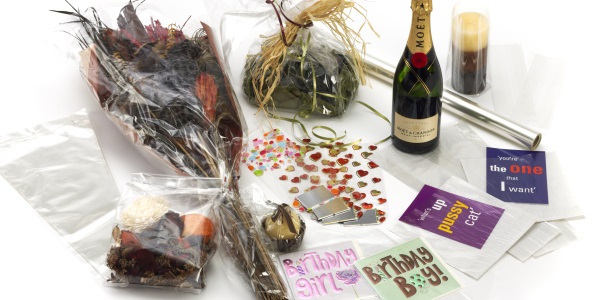
The use of retail display bags
Retailers everywhere have two important concerns when it comes to displaying their products:
- presenting their products to customers in the most attractive way possible
- maintaining the quality of the product and, in the case of food, preserving its freshness
By addressing these concerns, the retailer increases the likelihood of customers buying their products, thereby increasing their takings.
One of the most popular methods of presenting products in the retail environment is through the use of display bags. Display bags are versatile, attractive bags with a wide variety of uses, from presenting clothes to gift cards and flowers to food but, whatever the product, the ultimate aim for the retailer remains the same - impress the customer!
Display bags are traditionally made from either cellophane or polypropylene, two materials which, whilst similar, have their own important characteristics which affect the all-important presentation of the products concerned.
Why use polypropylene bags instead of cellophane bags?
Most people have heard of cellophane - a thin, transparent paper-like sheet made of processed cellulose that has high clarity. Cellophane is heat sealable and is able to resist moisture and other contaminants whilst keeping products fresh, which makes it a good product for displaying food and other retail goods.
Polypropylene is a less well know product, but it offers an excellent alternative to cellophane for use in display bags or film, offering many of the same benefits as polythene with some added ones thrown in.
Polypropylene is similar in appearance to cellophane but, whereas cellophane is a paper-based material, polypropylene is a plastic polymer, similar in many ways to polyethylene - the material traditionally used to make so-called polythene bags.
Like cellophane, polypropylene is heat-sealable and non-porous, providing an excellent barrier against moisture and other contaminants. As a result, polypropylene - also know as PP or Poly-Prop - is highly effective at keeping food fresh and meets the European Food Safety Authority (EFSA) and the U.S. Food and Drug Administration's (FDA) specifications for food content.
While similar to cellophane, polypropylene has a number of distinct advantages over its packaging ‘cousin', namely:
Price - the most obvious difference is that polypropylene does the same - or better - job than cellophane but is cheaper, offering great value for money
Clarity - polypropylene is an exceptionally clear material, providing higher clarity than cellophane. Polypropylene is typically used when maximum clarity is required, e.g. when packaging sweets, greeting cards, etc. The material's superb, crystal clear clarity and extra shine enhances the display of any product or design.
Strength - Polypropylene feels stronger and stiffer than cellophane when comparing bags/sheets of the same thickness. Cellophane is transparent but the film is thin and creases easily.
Temperature-resistance - Polypropylene has a better resistance to high temperatures, as it does not start to soften until approximately 270 degrees Fahrenheit
These factors combine to make polypropylene the most popular material for display bags, to enhance product presentation whilst preserving freshness. It is the perfect material for a range of packaging, from greeting cards to food.
With green issues increasingly high on the public agenda, the fact that cellophane is a natural product and 100% biodegradable has, of late, made it more popular as a food wrapping with many people.
However, whilst the product itself is organic, the manufacturing of cellophane is a toxic process. The process - which involves the production and extrusion of viscose, before re-converting it into cellulose - produces carbon disulfide and other polluting by-products.
Although plastic packaging often experiences a bad press, it is actually one of the most efficient forms of packaging, as it has both a very low carbon footprint and the ability to be recycled. Polypropylene is more eco-friendly to manufacture than cellophane. It is totally non-toxic for disposal and is also 100% recyclable.
Advice from the web on cellophane bags
Flower sleeves
Flower sleeves need to display the product properly, and clarity is the first thing that affects that impression. A superb polypropylene sleeve stays bright and transparent instead of clouding the display, so stems and petals remain visible through secondary packing and on the shop floor. That matters when a buyer is judging freshness and presentation at a glance, because dull film can make flowers see tired before they are. High gloss also assists the sleeve feel cleaner and more superior in hand, while still keeping the pack light and easy to handle. When the material is chosen well, the display works harder without adding additional layers or weight.
Best match for greeting card bags
Greeting card bags need a proper film specification if they are to give a clean retail stop without causing trouble on the line. Clear polythene suppliers with a consistent gauge runs more smoothly through forming and sealing equipment, while uneven film thickness can pull differently, scuff at contact points and make the pack see cloudy rather than fresh. Once the material beginnings varying, feeding becomes less proper and seal quality slips, which creates stoppages and rejects that eat into output. A tidy-looking bag is only half the job; it has to convert cleanly as well.
Polypropylene Bags, High Clarity Bags for Sale close me Bulk
High clarity bags in oriented polypropylene give a cleaner, more tidy see on the shelf or select face, and that matters when the product has to be seen as well as protected. The firmer film grasps its shape better than softer polythene suppliers, so packs sit straighter in outer cases and do not slump into each other as easily amid storage or dispatch. That rigidity also assists when packs are stacked or moved through busy warehouse systems, because the contents are less likely to wrinkle or distort. Where presentation and control both count, a stiffer transparent bag normally earns its place.
Types of Retail Bags to Match your Business Needs
Retail bags have to do far above only grasp a product together, because a weak bag can slow packing and create damage before the package even leaves the building. A superb design requirements enough film strength to cope with light accessories as well as heavier boxed products, while the seams stay intact when bags are dragged across benches or stacked in transit. The soft inner layer assists the bag resist scuffing and tearing where rough edges would normally grasp. If the seal closes cleanly and the gauge is proper for the contents, dispatch runs more smoothly and less products come back as returns.
Cast Polypropylene Packaging Films Market 2020: Know about Top Key Players like- Bhineka Tatamulya Industri, Mitsui Chemicals Inc, packaging suppliers
Polypropylene packaging has earned its place in trade because it balances stiffness, clarity and cost in a method that suits a wide spectrum of packed products. Cast polypropylene film, in specific, runs well on converting lines and gives a tidy pack with superb gloss and consistent thickness, which assists when seal quality and presentation both matter. Its behaviour is not identical to other plastics, though, so gauge selection, film tension and machine settings need matching to the product and the pack style. That sort of control reduces waste on the line and lowers the chance of awkward handling later. A sound specification gives better results than simply selecting the cheapest roll.
Polyprop packaging tape works well on carton sealing because it grips quickly without fighting the operator or jerking off the roll. That balance matters on busy packing benches, where speed is only useful if the tape lies flat and seals cleanly first time. A lighter acrylic grade normally suits smaller consignments and calmer storage conditions, while a stronger rubber adhesive can cope better with heavier boxes or rougher handling in transit. The proper selection relies on how the carton will travel after the bench, not only on how it sees in the dispenser. A matched specification cuts popped flaps, retains the line moving, and leaves less fixing-up work later.
Crystal transparent bags are judged first on how well they display the product, nevertheless that clarity only works if the film still behaves properly in production. A bag can see almost glass-like and still cause trouble if the gauge wanders, the seal window is also narrow, or the polythene suppliers blend lacks enough balance between stiffness and drawability. On the line, that shows up as inconsistent sealing, poor registration, and bags that fold or scuff also easily in cartons. Good conversion retains haze low without leaving the material brittle, so the finished pack retains its shape and appearance through packing, stacking, and dispatch.
Details about TOP QUALITY CLEAR CELLOPHANE DISPLAY BAGS FOR GREETING CARDS CRAFTS - ALL SIZES
Display bags for greeting cards and craft products need the proper balance of stiffness and clarity if they are to work properly on a packing line. A proper-gauge polythene suppliers film stands open more reliably, so the mouth is easier to retain below control whether filling is done by hand or through a machine. That reduces fumbling at the bench and assists the pack see tidy on the shelf. If the film is also soft, the opening collapses and slows production; if it is also rigid, the pack can crack at the weld when handled roughly. A sensible film selection retains output proper and avoids wasting time on damaged bags.
Polypropylene is often chosen as a substitute to normal sisal baler twine because it gives steadier performance on the bale press and is less affected by damp storage. Natural fibre can swell, weaken and fray, which makes tension less predictable when the machinery is running hard. A superb polypropylene twine retains its strength across the spool, so the baler can grasp shape without constant adjustment or messy breakage. That matters on busy farm and waste-handling lines where stop-beginning production wastes time and creates untidy bales. The practical earn is simpler running and more proper bale formation.
Wholesale Polypropylene Bags at guaranteed lowest prices
A small polypropylene bag can cause proper problems if the film gauge, seal line and slip level are not matched properly. Even at 3" x 5 1/2", a small change in thickness can affect how cleanly the mouth opens at the packing bench, how fast the bag slides into a secondary pack, and whether sharp or dusty contents put strain on the side welds. The material is often chosen because it stays fairly rigid and transparent, which assists with stock identification at the select face and retains line work moving, nevertheless that same stiffness can bring static and awkward separation in dry conditions. Careful conversion and well-set sealing normally retain those issues below control, and the result is steadier packing with less rejects.
Say 'I love you' with flowers in crystal clear wrapping
 Flowers are the perfect way to say 'I love you' to the special one in your life, a family member or loved one. Whether for a special occasion such as Valentine's Day, a wedding anniversary, a birthday or Mother's Day, or just to make someone smile at any time of year, flowers make people feel special and loved.
So, with such a simple but powerful gift, you want a simple but powerful way of making the flowers look their absolute best and putting all of the focus on the gift itself, which is why they should be wrapped in crystal clear flower sleeves.
Made from polypropylene, these high clarity sleeves are perfect for any flowers, from a single stem to a massive bouquet. Offering a fantastic sheen and excellent strength and designed for counter-top use and easy storage, flower sleeves are perfect for specialist florists and other gift retailers who sell flowers.
So make sure ultra-clear polypropylene wrapping makes your flowers shine so that the message 'I love you' is as crystal clear as the sleeves themselves.
Common uses of high-clarity polypropylene in the retail sector
Polypropylene is used to enhance the display of a wide range of products. Here are just a few of the ways it is used:
- Greeting card bags
- Flower sleeves
- Candy sweet bags
- Floral/basket wrap
- Media packaging (e.g. CDs, DVDs)
- Magazine overwrapping
- Clear wrapping film
- Clothing display bags (e.g. t-shirts, shirts, dresses)
- Food display bags (e.g. sandwiches, pastries, cakes, cookies)
- Art display bags (e.g. portraits, prints, calendars)


